
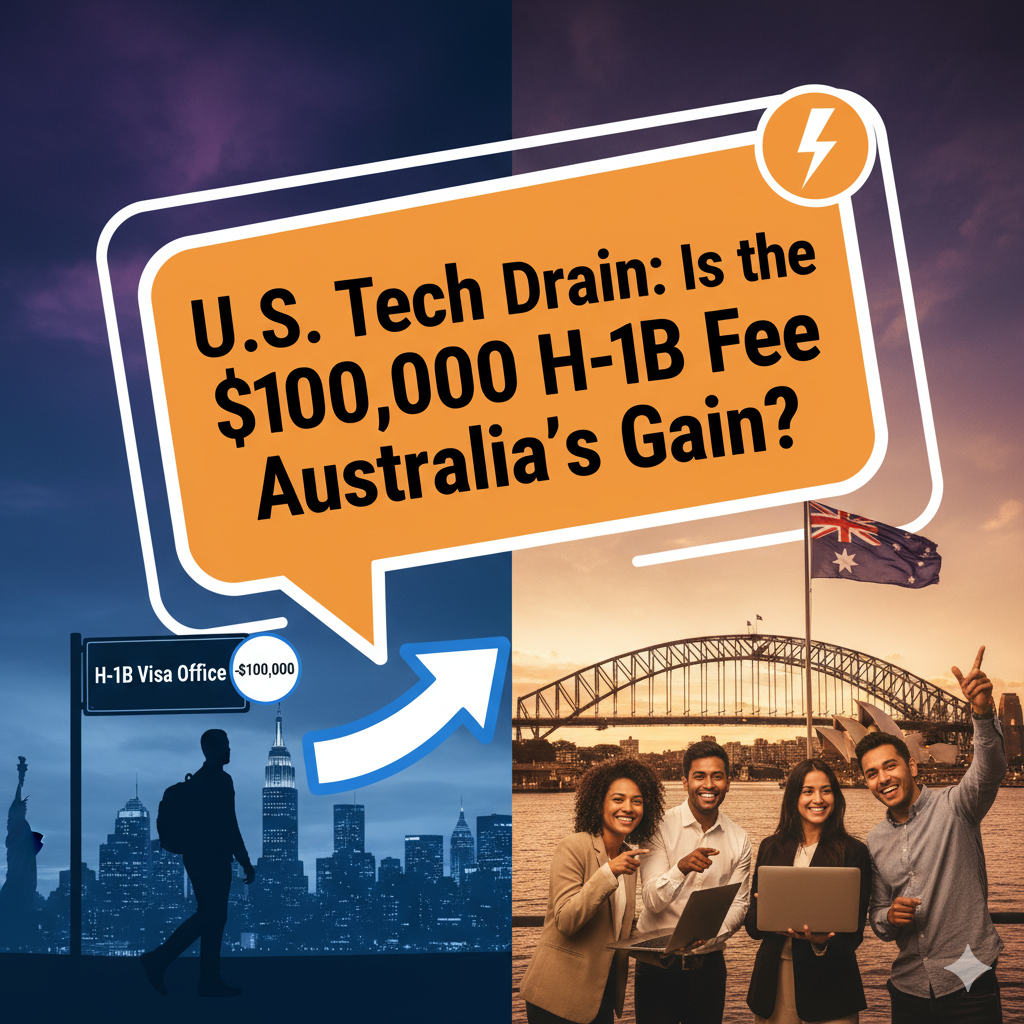
The U.S. has just imposed a staggering $100,000 fee on new H-1B work visas for workers currently outside the country, effective September 21, 2025. This unprecedented policy shift creates an enormous barrier for skilled Australians and fundamentally alters the global landscape of highly skilled migration. While it derails the American Dream for many, it presents a potential windfall of talent and opportunity for the Australian market.
The New $100K Wall: What Australians Need to Know
The H-1B is the primary non-immigrant work visa used by U.S. companies—particularly in tech, engineering, and healthcare—to hire highly skilled foreign professionals. The new Proclamation, signed by the U.S. President, targets its impact on new entrants:
-
The Sticker Shock: A one-time supplemental fee of $100,000 USD must now accompany any new H-1B petition filed for a beneficiary who is outside the United States. This is paid by the sponsoring U.S. employer.
-
The Scope is Narrow (But Critical): This fee does not apply to:
-
Australians already working in the U.S. on a valid H-1B visa (renewals and extensions are exempt).
-
Australians who had their petition filed before September 21, 2025.
-
Australians utilizing the E-3 Visa (the special U.S. visa for Australian citizens).
-
-
The Hidden Cost: This is a financial hurdle of over $150,000 AUD (depending on exchange rates) added to the cost of a single hire. This cost is borne by U.S. employers, but the effect is a dramatic reduction in job offers for foreign talent.
The Immediate Impact on Australian Talent
For skilled Australian professionals, the golden pathway to Silicon Valley has suddenly become incredibly narrow:
1. The Death of the Entry-Level Opportunity
The most significant casualty is the early-career Australian professional. A U.S. company is highly unlikely to spend $100,000 on top of a starting salary for a recent graduate or junior software engineer. This disproportionately affects younger Australians hoping to start their international careers in the U.S. tech hubs.
2. Prioritising the "Indispensable"
The H-1B is now functionally reserved for senior, highly-specialised, or executive-level talent. Only when an individual’s expertise is deemed truly irreplaceable—and their value to the company immediately outweighs the enormous fee—will an employer consider sponsorship.
3. The E-3 Visa Becomes the King (With a Catch)
The new policy exponentially increases the value of the E-3 Specialty Occupation Visa for Australian citizens.
-
The E-3 remains exempt from the annual H-1B cap and the new $100,000 fee.
-
It is the immediate, low-cost option for any Australian with a degree looking for temporary employment in the U.S.
-
The Catch: The E-3 is generally considered a non-immigrant visa (lacking "dual intent"), meaning it can be difficult to transition directly to U.S. permanent residency (Green Card) without complex and costly strategic planning.
The Australian Business and Economic Implications
While the fee is designed to protect American jobs, its immediate effect will be to influence global talent flows and business strategy, potentially creating a significant opportunity for Australia.
1. Accelerated "Onshoring" of Talent
If U.S. companies can no longer afford to import talent, they must hire locally, or they will export the jobs. Major U.S. multinationals (and Australian companies expanding abroad) may choose to accelerate investment in their Australian-based tech and research hubs. It is far cheaper to hire a highly skilled Australian for a team in Sydney than to pay a $100,000 fee to bring them to Seattle. This could lead to a repatriation of tech jobs and a stronger local employment market.
2. The Talent Magnet Effect
This prohibitive fee instantly makes other countries more competitive in the race for global talent. Australians and other skilled migrants (particularly from India, the H-1B's biggest user group) who are now locked out of the U.S. market will look elsewhere.
-
Canada's Advantage: Canada, with its welcoming immigration policies and competitive Global Skills Strategy, stands to be the biggest beneficiary.
-
Australia’s Opportunity: Australia’s existing skilled migration program (Subclass 189/190/491 visas) and the simplified Global Talent visa offer clear, affordable pathways to residency. Australian companies and recruiters must seize this moment to target the talent that the U.S. is deliberately pushing away, positioning Australia as the most stable, desirable, and financially viable destination for high-skilled professionals in the Asia-Pacific region.
3. Further Pressure for Merit-Based Selection
The $100,000 fee is not the only change. The U.S. is also moving to replace the existing H-1B random lottery with a wage-based selection system. This will heavily favour applicants with the highest salaries (Wage Levels IV), further ensuring the visa is only used for the best-paid and most senior roles. This combined approach makes it clear: the era of the H-1B as a general pathway for skilled temporary work is over.
What Should Australians Do Now?
This new policy requires a strategic pivot for anyone with a U.S. career on their horizon:
-
Stop Relying on the H-1B Lottery: If you are outside the U.S., assume the H-1B cap lottery is no longer a viable option due to the fee.
-
Max Out the E-3: If you are an Australian citizen, explore every opportunity to use the E-3 visa for your U.S. transfer. For your employer, it’s a zero-fee alternative.
-
Hone In on Specialisation: To clear the $100,000 bar, you need skills that are rare and immediately profitable. Invest in your expertise to ensure you are valued as an indispensable asset rather than a general specialist.
-
Recalibrate Global Plans: Objectively compare the total cost, compliance burden, and pathway to permanent residency in the U.S. versus rival nations. The U.S. may still offer the highest ceiling, but Canada and Australia now offer the highest floor of stability and ease of entry for skilled migration.
The U.S. has built a massive financial barrier for new skilled workers. For Australia, this could be the catalyst that brings world-class talent back home, cementing its status as a premier destination for global professionals.