
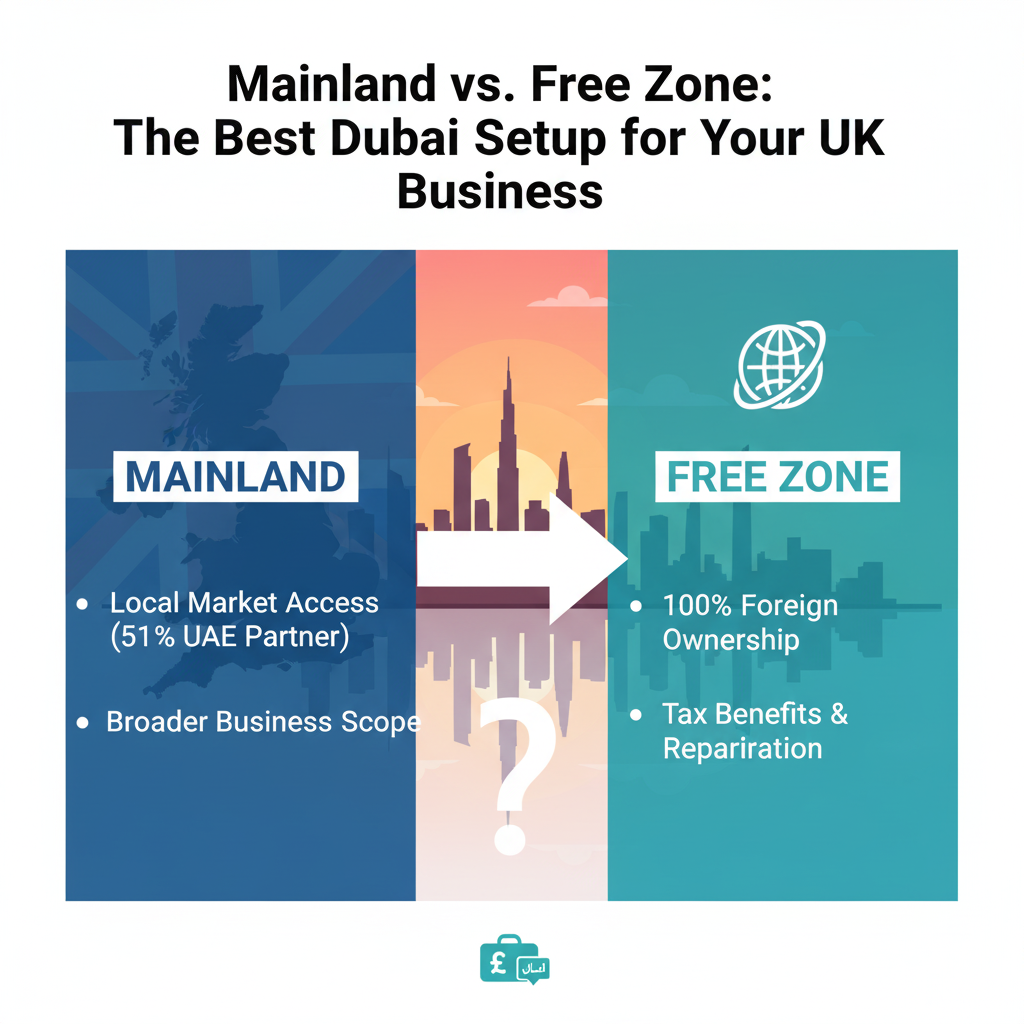
The prospect of moving your operations to the United Arab Emirates—a global business hub offering a strategic location, a tax-efficient environment, and a gateway to the MENA region—is immensely appealing for UK entrepreneurs. But before you can fully leverage the advantages, the critical first decision is selecting the right jurisdiction: Dubai Mainland, Abu Dhabi Mainland, or one of the UAE's many Free Zones.
Making the wrong choice can severely limit your market reach, increase compliance costs, and hinder future growth. This comprehensive, user-intent-based guide is specifically designed to help UK business owners navigate the intricacies of business setup in Dubai from UK and determine the optimal path for their venture, whether it’s a full market entry via Abu Dhabi mainland business setup or a nimble, international trading operation.
1. Understanding the UAE's Core Jurisdictions
When exploring how to start a business in Dubai from UK, you'll encounter three primary options, each with distinct rules governing ownership, market access, and licensing. The choice will be directly tied to your commercial goals and intended operating model.
A. The Mainland (Onshore) Company
A Mainland company, whether established in Dubai or through Abu Dhabi mainland company formation, is licensed by the Department of Economic Development (DED) in the respective emirate. The key benefit of this setup is unrestricted access to the entire UAE local market.
Key Advantages for UK Businesses:
- Unrestricted Trading: Mainland entities can trade directly with other mainland companies, government entities, and local consumers across all seven emirates. This is crucial if the UAE domestic market is your primary target.
- Government Contracts: Mainland companies are the only structure eligible to bid directly for lucrative local and federal government tenders and contracts.
- 100% Foreign Ownership: Following landmark legal reforms, most business activities across both Abu Dhabi Mainland and Dubai Mainland now permit 100% foreign ownership, removing the historical need for a local Emirati partner in most sectors.
- Office Flexibility: You can lease commercial office space anywhere in the respective emirate (Dubai or Abu Dhabi), offering freedom in choosing prime business locations.
Ideal For: Companies targeting B2C sales, retail, large-scale services, construction, manufacturing, and businesses where local market presence and government interaction are essential.
B. The Free Zone Company: Tax Efficiency and Control
Free Zones are special economic areas set up to encourage foreign investment. They are governed by their own independent Free Zone Authority (FZA) and offer a streamlined, investor-friendly environment.
Key Advantages for UK Businesses:
- Tax Incentives: Free Zones have historically offered 100% exemption from corporate and personal income tax, 100% transfer of capital and profits, and 0% customs duties for trading within the zone or internationally. Note: Under the new 9% UAE Corporate Tax, some Free Zone businesses may retain these benefits if they meet specific "Qualifying Income" criteria.
- 100% Foreign Ownership: This has always been the Free Zone standard, providing complete control to the UK owner.
- Simplified Setup: The Free Zone authorities often provide a quicker, more straightforward registration process, often including affordable flexi-desk or virtual office options, which significantly lowers initial operational costs compared to the physical office mandate on the Mainland.
Market Limitation: A Free Zone company can conduct business globally and within its own Free Zone, but it cannot directly trade in the Dubai mainland market without partnering with a local distributor or establishing a Mainland branch (requiring a dual license).
Ideal For: Export-oriented businesses, consultancies, e-commerce, international traders, freelancers, and businesses whose primary client base is outside the UAE or within other Free Zones.
C. The Offshore Company: Asset Protection and Privacy
While not designed for day-to-day operations, the offshore business setup Dubai (or in other offshore jurisdictions like RAK International Corporate Centre) offers a specialised, non-resident entity.
Key Advantages:
- Asset Protection: Primarily used for holding assets, intellectual property (IP), or acting as a Special Purpose Vehicle (SPV).
- Tax Structuring: Offers a framework for international wealth management and privacy
- No Physical Presence: No office space is required, making it the lowest-cost structure for holding purposes.
Major Limitation: An offshore company cannot conduct business within the UAE, cannot rent a physical office, and cannot apply for UAE residency visas.
Ideal For: UK businesses focused purely on international holding, inheritance planning, and asset protection outside of the operational entity.
The Abu Dhabi Mainland Company Formation Advantage
While Dubai Mainland is often the focus, setting up in Abu Dhabi Mainland offers unique strategic benefits, particularly for businesses in sectors like energy, technology, or finance. Abu Dhabi is the capital and largest emirate by land area, with a powerful regulatory body and a strong emphasis on industrial and high-tech sectors. For UK companies seeking government contracts or large-scale industrial projects, the capital is often the preferred point of entry.
3. How to Start a Business in Dubai from UK
The process for a UK national to get their business licensed in the UAE is streamlined, but professional guidance is highly recommended to avoid common pitfalls.
Step 1: Define Your Activity and Jurisdiction
The very first step for business setup in Dubai from UK is to accurately define your commercial, professional, or industrial activity. This determines your license type and, critically, where you must set up.
- Are you a consultant serving international clients? → Free Zone is likely best.
- Are you opening a retail outlet in a Dubai mall? → Dubai Mainland is mandatory.
- Are you a large UK energy firm seeking Abu Dhabi contracts? → Abu Dhabi Mainland Company Formation is the strategic move.
Step 2: Choose Your Company Name and Structure
Reserve a name with the relevant authority (DED, ADDED, or FZA). Ensure it adheres to the strict UAE naming conventions (no religious, offensive, or already-registered names). Decide on the legal structure—typically a Limited Liability Company (LLC) or a Branch of your UK Company.
Step 3: Initial Approval and Drafting Documents
Apply for initial approval from the licensing authority. Once approved, you will draft the Memorandum of Association (MOA) and Articles of Association (AOA), which will need to be notarised.
Step 4: Secure Office Space (Mainland Requirement)
If opting for a Mainland setup, you must sign a commercial lease. This tenancy contract is then registered with the authorities (Ejari in Dubai, Tawtheeq in Abu Dhabi) and is a mandatory precursor to receiving your license. Free Zone businesses complete this by choosing a flexi-desk or a physical office package from the FZA.
Step 5: Final Submission, License Issuance, and Visa Application
Submit all notarised documents, the tenancy agreement, shareholder/director passport copies, and pay the final license fees. Upon issuance, you receive your trade license. This license is the key document required to:
- Open a corporate bank account.
- Apply for investor/partner visas for yourself and residence visas for your employees.
4. Why UK Businesses Need a Local Partner
The complex choice between Abu Dhabi Mainland Business Setup, Dubai Mainland, and a Free Zone is often the most significant hurdle. A business setup consultant acts as your local expert, ensuring compliance and efficiency.
We provide a seamless service for UK entrepreneurs, covering:
- Strategic Jurisdiction Planning: Helping you choose the jurisdiction that best aligns with your target market and budget.
- Documentation and Legal Certification: Managing the entire bureaucratic process, from initial approval to final license issuance.
- Corporate Tax Guidance: Advising on the latest corporate tax laws to ensure your structure—especially for Free Zone entities—maximises tax efficiency.
- Fast-Track Banking: Leveraging our relationships with UAE banks to expedite the very complex corporate bank account opening process.
Don't let regulatory complexity slow your expansion. Our expertise is your faster.
FAQs:
1. What is the difference between Dubai Mainland and Free Zone for a UK business?
The primary difference is market access. A Dubai Mainland company can trade freely across the entire UAE local market and deal with government entities. A Free Zone company can only trade within its zone or internationally. If your business goal is to serve local UAE residents, Mainland is mandatory. If you focus on exports and international services, choose a Free Zone for its superior tax and cost benefits.
2. Can I have 100% foreign ownership of a company in Dubai or Abu Dhabi?
Yes. Recent federal law reforms permit 100% foreign ownership for UK investors in the vast majority of commercial and industrial activities across both the Dubai and Abu Dhabi mainland business setup jurisdictions, as well as in all Free Zones.
3. What are the pros and cons of an offshore business setup Dubai?
Pros: Excellent for international asset holding, intellectual property protection, and high privacy (no public register). It is also the lowest-cost setup. Cons: It cannot conduct any commercial activity within the UAE, cannot rent an office, and does not qualify the owner or employees for a UAE residency visa. It is a holding entity, not an operating entity.
4. What is the approximate cost and time to start a business in Dubai from UK?
Costs vary significantly by jurisdiction and office choice. A Free Zone setup with a flexi-desk is the most affordable, often starting from AED 15,000–30,000 annually. A Dubai Mainland or Abu Dhabi mainland company formation with a physical office will have a higher initial cost. The timeline typically ranges from 1 to 4 weeks, provided all shareholder documents are in order.
5. If I choose a Free Zone, how can I access the Dubai Mainland market?
To sell directly on the Dubai Mainland market, a Free Zone company has two primary options: 1) Appoint a local, registered distributor or agent, or 2) Obtain a "dual license" by opening a Branch Office of the Free Zone company on the Mainland. The latter involves higher fees but grants direct market access.