Table of Contents
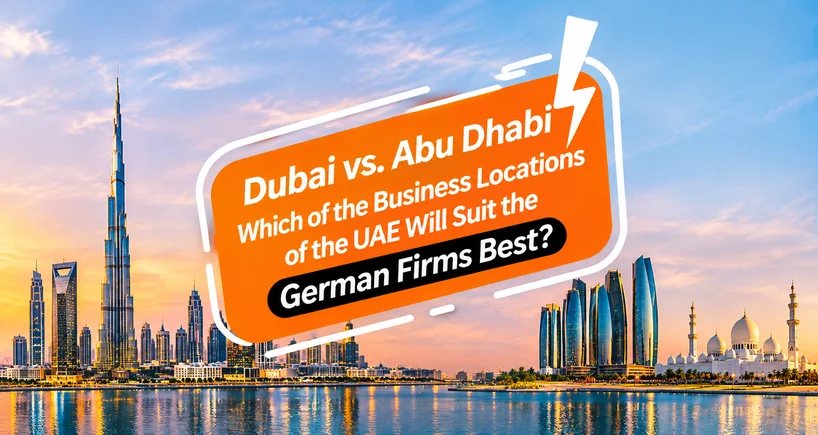
Dubai vs. Abu Dhabi-Which of the Business Locations of the UAE Will Suit the German Firms Best?
A growing number of German entrepreneurs and Mittelstand firms are establishing their presence in the UAE to take advantage of reduced taxation and regulation, as well as international market access. The choice of the UAE destination implies two options, Dubai vs Abu Dhabi for business.
They provide the same favorable conditions for international business as 100% foreign ownership and zero personal taxation, but the tax regimes are similar too. Nevertheless, there are some differences in terms of sectors and budgets of businesses that can be established in abu dhabi vs dubai.
Dubai: The Global Trade, Financial, and Logistics Hub
Dubai was founded on fast connections, global connectivity, and commerce flexibility. For German trading firms, consultancies, e-commerce firms, and banks, Dubai is an unparalleled starting point bringing Europe, Asia, and Africa to within a mere eight hours' flight time from one another.
When comparing Dubai vs Abu Dhabi for business, Dubai stands out for several specialized strengths:
- Superior Infrastructure for Logistics and Re-export: Having Jebel Ali Port and Dubai International Airport at its disposal, the city gives German exporters and machinery distributors access to easy shipment within the GCC countries and South Asia with minimal customs obstacles.
- Excellent Financial Systems: The Dubai International Financial Centre (DIFC) operates under the English Common Law regime, rendering it the best option for German asset management firms, wealth advisers, and cross-border holding structures.
- Specialized Free Zones for Business Activities: Such cities as DMCC, Dubai Silicon Oasis, and Dubai Internet City provide licensing schemes that are specifically aimed at software development, commodities trade, and B2B consulting.
- Established Community of German Expats: With about 30,000 Germans living in the city and having German expatriate business associations and German international schools there, executives and their families can adapt quickly.
Abu Dhabi: The Industrial, Clean Energy, and Sovereign Capital Hub
Only 140 kilometers down the coast, the UAE's federal capital operates on the scale of institutions. With over 90% of the nation's oil reserves and sovereign wealth funds exceeding 1.5 trillion US dollars managed here, Abu Dhabi pours huge sums of money into the diversification of its industrial base and manufacturing, as well as into green transition projects.
For a proper assessment of Abu Dhabi and Dubai, Abu Dhabi clearly beats Dubai in industrial sectors and high-end government-related industries:
- Advanced Manufacturing and Industrial Zones: Khalifa Economic Zones Abu Dhabi (KEZAD) provides industrial land, huge electrical capacity, and direct port connectivity perfectly suited for German companies specializing in mechanical engineering, the automotive industry, and chemical production.
- Clean Energy and Green Hydrogen Leaders: With Masdar City and national Net-Zero programs, Abu Dhabi is proactively partnering with German engineering companies in solar power, wind energy, hydrogen production, and power grid development.
- Institutional Finance at ADGM: Also, ADGM directly operates under English Common Law, thus inviting German family offices, venture funds, and institutional asset management firms that desire direct proximity to sovereign capital.
- Direct Government and B2G Procurement: German firms bidding on major infrastructure, healthcare, defense, or rail modernization contracts gain a decisive edge by establishing a local mainland presence in the capital.
Business Costs in Dubai vs. Abu Dhabi-Comparison for 2026
Accurate budgeting is an absolute must before any financial investment. While tax levels are standardized all over the federation, costs of operation may vary greatly in terms of choosing between Dubai vs Abu Dhabi for business purposes:
Company Formation and Licensing Fees: Abu Dhabi has reduced government license fees via ADDED, and typical mainland and free zone licenses cost about ≈ €1,215–€4,859. In contrast, similar Dubai packages usually cost ≈ €2,915–€8,503 based on visa quotas and permissions.
Costs of Commercial Office and Warehouse Space: DIFC and Downtown Dubai offer the most expensive commercial rent in the whole region. In Abu Dhabi, however, it will be much cheaper to rent commercial space in KEZAD and Mussafah.
Cost of Executives' Life and Personnel Expenses: Living, housing, and school fees in Abu Dhabi are up to 15%-25% cheaper compared to those in Dubai; thus, expatriate relocation allowances are lower for the German parent company.
Speed over Cost: Higher fees notwithstanding, in Dubai one will be able to obtain initial clients faster due to high footfalls and international buyer traffic.
Which City is Better for Startups? Dubai vs Abu Dhabi
Entrepreneurs building high-growth companies have a distinct strategic choice between the Dubai and Abu Dhabi startup ecosystems. Both cities cultivate their unique type of innovation:
- Why Dubai Beats for Fast-Scale Tech and Consumer Startups: Dubai brings unparalleled time-to-market, extensive angel investor ecosystems, and instant access to millions of rich consumers in the region. Fintech, SaaS, and eCommerce entrepreneurs flourish in the accelerators DIFC Innovation Hub and Dtec.
- Why Abu Dhabi Beats for Deep-Tech, Cleantech, and Research and Development Companies: Thanks to Hub71 and Masdar City, Abu Dhabi offers equity-free perks, subsidized housing, grants for research and development, and direct pilot projects with government-owned corporations. German startups creating AI hardware, biotech, cleantech, or automation get extended runway and institutional support in the capital.
- In the end, choosing Dubai vs Abu Dhabi for business depends on your business strategy: choose Dubai for fast-paced B2C and regional sales centers; choose Abu Dhabi for research and development and production facilities.
How Flyingcolor Supports German Companies in UAE Success
In order to expand your GmbH company or establish a new business in the Emirates country, just submitting an online application for a license is not enough. German companies should comply with the UAE legal regulations according to the UAE-German Double Taxation Avoidance Agreement (DTAA) and have real substance, including office rental agreements, directors' presence, and bank accounts in the UAE, so that Finanzamt cannot claim tax residency in Germany.
Flyingcolour Business Setup combines German perfectionism with Emirates practicality. Whichever emirate you choose, Dubai or Abu Dhabi, our experts will take care of jurisdiction choice, license application procedures for Mainland and Free Zones, document attestation in Germany, corporate banking, and the UAE Golden Visa application.
Conclusion: Selecting the Right Emirate for Your German Business Venture
There are no winners in the comparison between Dubai and Abu Dhabi when doing business; there is only the one emirate that fits your business model better. If you are aiming for quick access to the market, logistics of international business trade, and speed of delivery of goods to consumers, Dubai will be the ideal choice for launching your German business venture. If you are planning on getting involved in manufacturing, renewable energy sources, or sovereign funds, Abu Dhabi should suit your goals better.
FAQs
Q 1: Which city is better for German firms: Dubai or Abu Dhabi?
A: Dubai would be ideal for international trade, finance, logistics, and market entry, while Abu Dhabi is better at manufacturing, renewable energy, sovereign funds, and government contracting.
Q 2: Is it more affordable to establish a company in Abu Dhabi or Dubai?
A: Abu Dhabi is usually more affordable, with standard business licenses costing ≈ €1,215–€4,859 while office rent and cost of living are cheaper by 15-25% than in Dubai.
Q 3: Are corporate tax rates different in Dubai and Abu Dhabi?
A: No. Both Emirates have identical UAE federal corporate tax: 0% on profits up to AED 375,000, 9% above that level, and 0% for qualified free zone companies.
Q 4: Can German firms own their businesses in full 100% foreign share in both cities?
A: Yes. Dubai and Abu Dhabi allow 100% foreign ownership of businesses in free zones and the majority of mainland commercial and industrial activities without an Emirati partner.
Q 5: Which emirate is better for German startups?
A: Dubai suits fast-scaling fintech, SaaS, and consumer startups seeking rapid investor access, whereas Abu Dhabi (via Hub71 and Masdar City) favors deep-tech, clean-tech, and R and D ventures.