
Table of Contents
Company Formation in Dubai Mainland: How to Set Up with 100% Foreign Ownership
Yes, foreign investors can have 100% ownership of businesses with many different business activities on the Dubai Mainland. Primarily, it depends on the type of activity you are doing and what regulations apply to your business. You can set up a mainland company through Dubai’s Department of Economy and Tourism (DET). People earlier often called it DED.
To trade with customers across the UAE, consider a mainland set-up. It also helps you partner with local businesses. You can import goods on the mainland.
You can have a physical presence, office, or shop in approved local areas. These include Bur Dubai, Deira, Downtown, Business Bay, Barsha, and Dubai Marina.
A mainland set-up also supports government tender opportunities.
The challenge is to shortlist the business activity you want to do. I based this on your business ideas. You must also choose the legal structure you need. In most cases, it is either an LLC or a professional company.
You also need to decide where to locate your business. This is crucial for a shop that needs footfall. For example, the best place for a vegetarian Indian restaurant may differ from one for an English breakfast.
Get the required approvals before you pay for anything.

What is a Dubai mainland company?
The Dubai Department of Economy and Tourism (DET) will license a Dubai mainland company. Mainland companies are not limited to one free zone. They can trade across Dubai and the UAE.
However, it is worth noting that the UAE has seven emirates. These are Dubai, Abu Dhabi, Sharjah, Ajman, Umm Al Quwain, Ras Al Khaimah, and Fujairah. Each emirate has its own separate mainland authority.
DED is still a common term. People once called the DET the Department of Economic Development (DED). If you search for a ‘Dubai DED license process ’, you are looking for the current licensing process for mainland businesses.
You can license a variety of business types on the mainland, including commercial, professional, and industrial.
Under which circumstances do entrepreneurs choose mainland company formation instead of a free zone company formation in Dubai, UAE?
A mainland company is ideal for businesses looking to trade freely within the local market. Dubai's official investment site says that mainland companies can trade freely within the UAE as well as internationally.
This may be the right choice for you if you:
- Sell to customers in the UAE
- Have a physical presence (such as a shop, office, clinic, restaurant, etc.)
- Authorities generally allow trading across the UAE, but you must meet the required rules in other Emirates.
- It allows participation in Dubai Government tenders. Government contract rules generally prevent free zone companies from bidding for contracts.
- Create a local business in the UAE
Free zone company registrations in Dubai are usually low-cost compared to mainland registration. However, they are not the right choice for every business activity.
A DET license lets you deliver goods, provide services, and sign client contracts across the UAE. You must do this from your Dubai-based office or shop. However, it does not allow you to open an office, shop or warehouse in other Emirates under a DET license. You need to open a branch or a separate company to open an office, shop or warehouse in other Emirates.
Can a foreigner own 100% of a Dubai mainland company?
Businesses/companies can be 100% owned by foreigners for majority of business activities. Federal Decree Law No. 26 of 2020 allowed 100% foreign ownership for mainland companies. It took effect on 1 June 2021.
Later, Federal Decree Law No. 32 of 2021 replaced the legal framework. This law on commercial companies came into force on 2 January 2022.
Following amendments to the UAE Commercial Companies Law, most commercial activities can now be 100% foreign-owned. This has made the process of setting up a company on the mainland much more flexible. Before 2021, foreigners could own only 49% of a company’s shares. A UAE national had to hold the other 51%.
The UAE Government have specifically listed Strategic areas that may have restrictions on 100% foreign ownership. These include certain Security & Defence, Telecommunications, Banking, Finance, Insurance etc. activities.
What are the Dubai mainland company setup requirements?
You may need a range of documents. This depends on your activity type and your company type. Your premises location and any needed external approvals also matter. The Dubai Government has listed the main steps in setting up a company as follows:
- Deciding on your activity
- Deciding on company type
- Registering your trade name
- Obtaining initial approval
- Preparing the correct agreements and securing your premises
- Obtaining further approvals, as certain activities need approvals from Dubai Municipality, RERA or KHDA, etc.
- Paying any applicable fees
Documents usually required for mainland applications include:
- Copies of passports of shareholders/owners
- Proposed activity (this will determine the license category)
- Proposed trade name choices
- Application documents and initial approval
- Memorandum of Association (Notarised)
- Lease documents for your premises (called Ejari)
- External approvals (if required for your activity)
- Other documents depending on your company type, ownership and business activity
Does a Dubai mainland company need an office?
Businesses on the Mainland will generally require some form of physical office premises. This will depend on the nature of the business and the licensing route taken. The DET states that businesses must have a valid business address. In practice, this will mean that you will need to have an office or shop with a tenancy agreement and Ejari registered.
This can often lead to confusion when comparing fees between the Mainland and Free Zones. The majority of free zones are offering company formation packages with flexi desks which are comparatively low cost.
What is the Dubai mainland company formation cost?
No fixed government fee exists for establishing a company on the Dubai mainland. The cost of forming a company on the Dubai mainland depends on your business activity and legal structure.
It also depends on your office space needs. Office size depends on the number of visas you need.
Costs may also include approvals and other requirements.
To learn the exact cost for a specific business activity, it’s best to consult a trusted business setup firm.
Mainland vs Free Zone Company in UAE: Which One Should You Choose
|
Feature |
Dubai Mainland Company |
Free Zone Company |
|---|---|---|
|
Foreign Ownership |
100% for most eligible activities |
100% |
|
Trade Within UAE |
Direct mainland market access |
Generally, it requires a mainland-based distributor |
|
Government Contracts |
Generally eligible to participate, subject to tender requirements |
Eligibility depends on the tender, authority and applicable rules |
|
Office Requirement |
Physical address requirements apply |
Flexi-desk/virtual office options may be available, depending on the free zone and activity |
|
Visa Quota |
Linked to office space, activity and immigration rules |
Usually linked to the package, office space and free-zone rules |
|
Customs Duties |
Standard UAE customs rules apply |
Special customs treatment may apply to goods retained within a free zone; rules differ when goods enter the UAE mainland |
|
Corporate Tax |
Yes it is applicable as per FTA laws |
Yes, it is applicable except for tax exemption for a company located in a designated free zone with substance as per FTA laws |
|
Bank Account |
Corporate bank account can be opened in UAE local banks, subject to Bank due diligence and compliance |
Corporate bank account can be opened in UAE local banks, subject to Bank due diligence and compliance |
|
Business Activities |
2,000+ activities available across the UAE framework |
Activities depend on the selected free zone and its permitted scope |
|
Setup Cost |
Depends on activity, license, office, visas and approvals |
Depends on free zone, package, license and visa requirements |
|
Best For |
Local trading, professional services, physical businesses and UAE-wide operations |
International business, specialized activities, import/export and businesses suited to a free-zone model |
|
Regulatory Body |
Dubai Department of Economy and Tourism (DET), formerly DED |
Relevant Free Zone Authority |
|
Branch Offices |
Can establish branches subject to applicable licensing requirements |
Expansion outside the free zone may require additional approvals/licensing arrangements |
What is the Dubai DED license process?
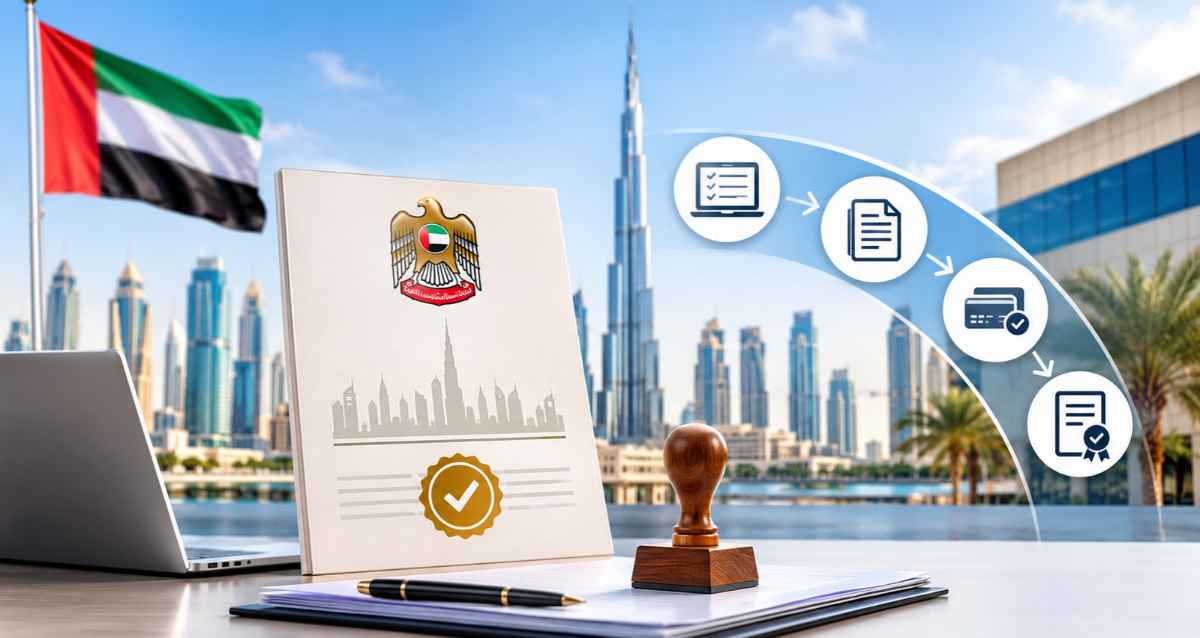
The Department of Economy and Tourism (DET) now issues Dubai Mainland licenses.
The official process for obtaining a license is as follows:
Step 1: Business Activity
This is the first step you should take.
This will determine what license you will need, as well as what legal structure you will need. The activity you do will determine the legal structure you need. The UAE Government has over 2000 different business activities.
If you choose a generic or incorrect business activity, this can cause issues later on. Ensure that your business activity matches what you will actually be doing.
Step 2: Legal Structure
The legal structure you will need depends on the activity and commercial requirements of your business.
Several legal structures are available to choose from. The most common are LLC (Limited Liability Company) and Branch. UAE law also allows other options.
Many options are available to choose from according to the official government guidance. Some examples include: Limited Liability Company, Public and Private Joint Stock Company, and Civil Company. Other examples are Sole Proprietorships, which carry the highest financial risk for the owner. This is because there is no limit on liabilities.
General Partnerships are another example, and all partners have unlimited liability.
Many foreign entrepreneurs will consider an LLC to set up their operating company. However, you should not do this without considering what activity they will need.
Those offering a professional service should consider if they need a professional license to provide it. This setup will require a UAE national service agent.
Step 3: Trade Name
Choose a name that meets the requirements and register it.
The trade name must meet naming rules. It must fit the activity and legal status. It must not already have a registration.
Step 4: Preliminary Approval
This shows the government have no objections to you setting up the business.
However, this does not mean you can start doing the licensed activity.
Some activities will require further approvals from relevant Government departments.
Step 5: Company Documents
Depending on the legal structure, you will need documents such as a Memorandum of Association.
This will depend on the type of company and ownership.
Step 6: Business Premises
You will need premises that meet the requirements. Generally, you will need suitable office space before the licensing authority issues the license. All companies on the Dubai Mainland will require office space. This will usually include an Ejari-registered tenancy agreement.
Some businesses may only require a small office. However, some businesses will have a large requirement for their premises, which can affect the cost of setting up.
Step 7: External Approvals
If your work is in a regulated field, you may need government approval. This includes health, education, food, finance, and legal services. This can make the registration process longer and more costly.
Step 8: Documents and Fees
Once you have completed the approvals and documents, you can issue the license through the correct Dubai Government channels. The UAE Government states that you must pay for the trade license within the time frame listed on the payment voucher.
How can Flyingcolour Business Setup help UAE business entrepreneurs?
Flyingcolour® Business Setup can help you plan your Dubai mainland company setup. Your business activity, ownership, and budget determine it. We will ensure that you choose the right setup.
We can help with:
- Choosing the correct business activity
- Choosing the correct legal structure
- Determining if you are eligible for 100% foreign ownership
- Trade name and initial approval
- Application for mainland trade license
- Documentation and incorporation
- Office and premises guidance
- Visa and immigration
- External approvals
- Bank account opening assistance
- Post-formation accounting and taxation
The benefit of using us isn’t just filling out forms.
We will help to link everything together.
Your business activity will determine your license, which will determine your premises and approvals. Your visa requirements will determine your budget. Your business activity will determine your tax and accounting requirements.
We can help you to review these factors together.
Frequently Asked Questions About Dubai Mainland Company Formation
1. Can foreigners own 100% of a company in Dubai Mainland?
Yes, foreign investors can own 100% of many Dubai Mainland businesses. What you’re doing and the applicable regulations will determine it. Activities that may have a strategic impact may have different requirements.
2. Do I need an Emirati Partner in Dubai Mainland?
The majority of activities do not need a UAE national shareholder. The UAE has a company structure that allows 100% foreign ownership. However, it will depend on what activity you are doing and what legal structure applies.
3. How much does it cost to set up a company in Dubai Mainland?
Setting up a company in Dubai Mainland has no set cost. The cost depends on your activity, legal structure, and government fees. It also includes office, visa, external approvals, and professional fees. A detailed breakdown of what your specific activity will cost is better to get.
4. What is the process for getting a License from Dubai DED?
DET manages the process for setting up a company in Dubai Mainland. Many still call it the DED process. The process will involve choosing your activity and legal structure, registering your trade name, and getting initial approval. You will then prepare documents, find office space, get any extra approvals, and pay the correct fees.
6. How long does it take to set up a Mainland Company in Dubai?
No set time frame exists for setting up a company in Dubai Mainland. It depends on your activity.
It also depends on how fast you can get your documents, office space, and approvals. Simple setups can take between a few working days to few weeks. Extra approvals can increase this time.
7. Do I need an Office in Dubai Mainland?
Generally, you will need an office or approved space for your business. This will depend on what activity you are doing and what license you are applying for.
Dubai Mainland companies will require an office to be physically present. The cost of having an office can impact your license, visa and overall cost. The UAE Government states that businesses must have a physical address.
8. What documents are needed to set up a company in Dubai Mainland?
You will usually need copies of shareholders' passports and details of your business activity.
You will also need trade name details and initial approval documents.
You will need incorporation documents, such as a notarised MOA and lease (Ejari) documents. Depending on your activity and structure, you may need extra documents or approvals.
9. Can I trade throughout the UAE with a Mainland Company?
Mainland companies let you trade within the UAE and internationally. Unlike free zones, they do not have any restrictions. According to Dubai’s official investment site, mainland companies can trade inside and outside the UAE. This includes free zones, as long as clients visit their Dubai-based office or shop.
10. Is Mainland better than Free Zone?
This will depend on your business. Mainland is a good option for direct access to UAE customers. It also helps if you need a local presence.
Also useful for bidding for government contracts.
If your activity and business fits with a specific free zone, then a free zone may be the best option for you.
You should consider your activity, customers, office, ownership and plans. The cheapest license may not be the best option. Consider if having a free zone structure in Dubai will stop you from trading locally or with the public sector.